Showing posts with label CE-2007-2008. Show all posts

Friday, March 21, 2008

Antarctic campaign blog digest


A blog post a day keeps the doctor away...

... or rather: a blog post a day adds up to a lot of pages. I have just finished compiling a pdf version of my posts from the Antarctica field trip into an 88-page book. The text is almost identical to that here on the blog (only minor tweaks were necessary to fit the format), but the image quality is much improved.

You can download the pdf file (all 13Mb of it) here: Sismordia-book.pdf.


-----
Keep up to date with the latest developments at http://sismordia.blogspot.com

Saturday, March 8, 2008

Antarctica photo album

Apologies to my regular readers for the recent lack of posts. I have been catching up on work after my two-month absence.

I have only just got round to organizing photos from the Concordia field trip. You can find a selection of photos in this Picassa album, also accessible through the image below. The pictures in this album were mostly taken by JY and me, though a few were taken by other Antarctic adventurers (you know who you are).


Antarctica 2007-2008


-----
Keep up to date with the latest developments at http://sismordia.blogspot.com

Tuesday, February 19, 2008

Home at last!

The sun is shining here in Strasbourg, and the temperature was a balmy -3°C at the time my plane landed. I will be taking the next few days off, and plan to be back in action again by sometime next week.

In the meantime, best wishes to all !

-----
Keep up to date with the latest developments at http://sismordia.blogspot.com

Saturday, February 16, 2008

Hobart - last day before departure

A cloudy morning in Hobart bay. We had been expecting summer conditions, but have found Tasmania in February to be pleasantly cool.

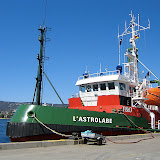
Yesterday upon arrival we were raring to set foot ashore and walk somewhere more than a few hundred meters away. Being stuck on a 65m vessel for five days tends to do that to you. We were also longing to get away from the ever present smell of exhaust fumes that have accompanied us day and night on the Astrolabe.

Our main stop was the botanical gardens of Hobart, which are well worth a visit. The colors, the smells, the feeling of grass underfoot... all things we had forgotten about after nearly 7 weeks in Antarctica, at sea or in airports. We spent a leisurely hour or so strolling in the gardens.

Today is Sunday, a day for a lazy stroll about the town, maybe visiting a few museums, or drinking coffee (or tea in my case) in a waterfront cafe.

Our departure is set for early tomorrow morning. I should be back home (and within reach of a computer) sometime on Tuesday.

Friday, February 15, 2008

Land ahoy

The fourth and fifth days of navigation have been much more pleasant than the first three. Calm waters have made a big difference to my comfort level... I am no longer seasick, even without the patch.

Yesterday evening we celebrated our last night at sea with the traditional party. Lots of music, lots of dancing, lots of drinking. The ship is very quiet this morning. I suspect a number of people will not be feeling too perky when they wake up.

It is a grey day, and there is a mist on the horizon. The southern tip of Tasmania is barely visible, rising above the mist. We should reach it in six hours time. It will be great to set foot on dry land again!

We shall stay in Hobart for the weekend, sleeping on the Astrolabe, and shall start our 24h plane journey back to France on Monday morning.

The adventure is nearly over. I am very much looking forward to being back home, but at the same time I am sorry to leave Antarctica behind. There is a magic about the place I cannot quite explain...

Thursday, February 14, 2008

Day three

This third day at sea has passed much like the two previous days. There is a moderate to strong sea-swell, which is making us roll severely (30 degrees either way). I'm doing OK at the moment, thanks to the sea-sickness patch.

There is not much to do on the Astrolabe to pass the time. One can read, watch films, work on a computer. I can do none of the above without feeling queasy. Other options are watching the sea from the bridge, or from the helipad at the rear of the ship. I spend most of my time either watching the sea from one of these two locations, or lying on my berth being rocked by the waves.

Eating on the Astrolabe requires willpower, and the certain knowledge that it is better to be queasy with something in the stomach than with nothing at all. Taking a shower is more challenging still!

We should have only another 48 hours at sea before we reach Hobart. Yay!

Wednesday, February 13, 2008

Second day at sea

Sea state : moderate swell

My state : patched, but still queasy and drowsy.

We are making good speed. At this rate we should arrive in Hobart Saturday afternoon. Fingers crossed!

Tuesday, February 12, 2008

First day at sea

Current location: S61° 50'.

Sea state: slight swell.

My state: seasick... ugh!

After having managed to keep down none out of the three meals taken on board, I have now opted for a seasickness patch. Hopefully things will be better tomorrow.

Monday, February 11, 2008

Departure from DDU

Last half-day at DDU...

We are expected to be on board the Astrolabe this afternoon, as our departure is set for early evening. Six days at sea await us... what a glorious prospect...

The day is bright and windy, which makes for great visibility, but choppy waters. The numerous icebergs that in the bay at the moment will escort us out to the open sea. I shall be sad to say goodbye to these ice-monsters.

Goodbye Dumont d'Urville, goodbye Antarctica! I hope to be back soon...

Thursday, February 7, 2008

Spot the birdie...

The sun is back, and with it the possibility to escape Dumont d'Urville base for a few hours. Today JY and I tagged along with two friendly ornithologists who had work to do on Lamarck island. We helped them count Adélie chicks, and put id tags on Snow Petrel and Cape Petrel chicks. The Snow Petrel nests are particularly difficult to find, as these birds hide in crevices in the rocks. We spent a very pleasant morning clambering over the island looking for them.

One thing I learned about Petrel chicks of both species is they projectile vomit in self-defense. Our friendly ornithologists got covered in the stuff, with one receiving a direct hit in the face... yum. My job was to help locate nests and write down the tag numbers. Even though I did not have to reach into the rocks to extract the chicks (I would not have known how to do so without hurting them) I still managed to get vomited upon.

Other notable events today: first sighting of Emperor Penguins in the archipelago and a partial solar eclipse.

Tuesday, February 5, 2008

The Astrolabe is back

The sun that bathed us most generously over the weekend (the photo above was taken last Sunday) has given way to two days of wind and snow. There has been so much cloud that at times we could hardly see over to the next building, let alone make out the continent or the icebergs in the bay.

The Astrolabe arrived offshore early this morning, but did not dare come into dock in such windy conditions with near zero visibility. It waited until early afternoon for the snow storm to clear, then gingerly inched onto the bay and to its mooring. It should stay here five days or so, time enough to unload its cargo (mostly fuel for the winter) and pick up its forty odd passengers (I shall be one of them) for the crossing over to Hobart.

If all goes as planned, I should be leaving here this coming Sunday or Monday. Although the prospect of a 5-7 day crossing through rough seas the flat-bottomed Astrolabe doesn't really fill me with anticipatory joy, I shall be glad to be on my way home at last.

Sunday, February 3, 2008

Adélie chicks

Petrel Island and Dumont d'Urville itself are home to a vast colony of Adélie penguins. They are everywhere, on every scrap of rock. They are cute little critters, once you get used to their smell and raucous calls. Many an hour can be whiled away by watching their comic antics, as they come and go from the sea, steal stones from each other's nests and feed their young.

The Dumont d'Urville colony has been under continuous study for a number of decades, and there is at least one marine ornithologist at the base at all times. Today, JY and I volunteered to help weigh some of the Adélie chicks born to the one hundred couples under study this year. Together with the resident ornithologist, we tracked down the correct chicks among the rocks, weighed them, measured the length of their right aileron, and removed their identification tags.

The chicks were all between 42 and 45 days old, weighed between 3 and 4 kilograms each, and had started to shed their downy fur for more sea-worthy feathers. They will soon complete their transformation and take to the sea for the winter. The chick I am carrying in the photo was, at 2.75 kg, the smallest one we weighed today, and still had all of its down. It was very placid and soft to the touch: a pleasure to hold

Saturday, February 2, 2008

Prawn cocktail anyone?


Another beautiful day on Petrel Island, and another fishing trip, far more successful than the last one I described. Part of this morning's catch is shown in the photo above.

The spot we went to was the same as the one we visited two days ago, but the ice scenery was entirely different. In two days most of the bergs had drifted to new positions. Some of the larger tabular ones had lost parts of themselves through calving, and one of them had flipped on its side. We just missed seeing a large chunk calve off a tabular berg. We heard it though, and saw the resulting wave and ice-debris: impressive!

Friday, February 1, 2008

Community life...

One of the pleasures of living the Dumont d'Urville life is being on cleanup detail every now and again. This detail includes laying the tables, serving, clearing and washing up after three meals, as well as cleaning all communal living areas. Three people are assigned to this detail every day, with one of the three on lighter "backup" duty.

I was "backup" in today's cleanup detail. In order to avoid what I consider to be the worst aspects of the job (floor and toilet duty) I volunteered from the start to do all the washing up. I had already had some experience at washing up efficiently for this number of people atConcordia, where I was on "dishes detail" twice in two weeks (the second time was the day I left - the last thing I did at Concordia was wash dishes...).

For my family and others who know me well and may have trouble believing I could wash up three times a day for sixty people, the photo above should serve as proof...

Thursday, January 31, 2008

Fishing expedition

Sunshine makes a world of difference! Today we finally had blue skies again, after nearly a week of cloud, wind and snow, so we celebrated by going on what was supposed to be a photo-tour. The first stop on our tour was the quay, from which we had planned to start circum-walking the island, keeping as close to the water and sea-ice as possible, so as to get good pictures of penguins, seals and aesthetically pleasing ice formations.

Instead we found a group of "ornithologists" preparing for a fishing expedition (actually marine biologists, not bird experts, but any life-scientist seems to be called an ornithologist here). They promptly invited us to join them. After dropping a cage for catching crustaceans in the open waters of the bay, we navigated to a quiet spot sheltered by icebergs, and started dredging the bottom of the bay for whatever happened to live there.

We managed three runs before the hydraulics powering the winch broke down, and we were forced to raise the last dredge-pan by hand. While the marine scientists and JY had fun poking around in buckets filled with odd, spindly, spiky, gooey marine creatures (not really my kind of thing), I spent time taking in the spectacle of icebergs at close quarters.

They are a magnificent sight, glistening in the sunlight, changing color and shape depending on which angle you view them from. Some have had caves excavated in them by waves, others have been sculpted into soft shapes by wind and water. Yet others are tabular, and in the right light you can see they are stratified like sedimentary rocks (the "sedimentation" is actually snow accumulation) and traversed by fault-lines and crevasses.

It was cold on the water despite the sunshine. We had not expected to be taken fishing and had not dressed accordingly... However, the opportunity to spend time close to those fascinating ice-monsters was well worth it!

Wednesday, January 30, 2008

Snow!

The wind is dying down, it no longer buffets us as strongly. Walking has become easier, and it is even possible to find the odd place where the air is almost still. Such spots are great favorites with the amateur photographers of the base, as the views onto the Antarctic continent can be spectacular.

Can be. The continent, although it is distant no more than a couple of kilometers, is not always visible. Today it is hiding... It has been snowing since this morning, small unstructured flakes whirling around in the diminishing wind, gently coating the whole base in a mantle of whiteness, and hiding the continent from view. It is the first time I have seen it snow since arriving in Antarctica.

In Concordia it hardly ever snows. We experienced winds that lifted the surface snow into a blizzard, reducing visibility to a few meters, and creating artistic snow drifts, but no real precipitation. The annual accumulation up there is around two centimeters a year... dryer than many deserts!

Here at sea-level there is more humidity in the air, more weather-related phenomena, and more snow... The past few days, the opportunities for photography have been a little scarce, because of the winds and now the snow. The photo above was taken a few days ago by JY, when we went out onto the sea-ice to visit the seals. Cute and cuddly... ahem... so long as you don't get too close...

Tuesday, January 29, 2008

Electricity

Shocks from static electricity are something we all experience everywhere.

Just shuffle your rubber-soled shoes against the carpet on a dry day and you can be sure to get a spark from the next metal object you touch. Over here in Dumont d'Urville it takes very little indeed to provoke a spark of static electricity.

Every time I take my fleece jacket off, or pull on my woolly hat, I knowI'm charging myself up. Every time I put out my hand to a door handle a spark goes off. Some parts of the base are worse than others. I have not yet managed to enter the far side of the meteorological building without getting a jolt off its door. In Concordia it was even worse than it is here: I would get a spark of the door handle at the bottom of the stairs, only to get another one off the other door handle at the top.

Sparks of this kind can be quite dangerous for computers and other electronic equipment. Everyone has stories of having killed one machine or another via a particularly nasty jolt of static. So we take precautions, and usually try to discharge ourselves against a metal door or wall before touching anything sensitive. I used to find it odd to watch people knock against metal surfaces before reaching out their hand. Now I fiind myself doing the same... a shock off a knuckle is not nearly as annoying as one off the fiingers!

As the saying goes, when in Rome...


Monday, January 28, 2008

Windy weather

All it takes is a depression off the coast somewhere...

It has been windy ever since I set foot in Dumont d'Urville, normal, every-day wind of the "hold on to your cap" variety. Last night the wind got bored of being so reasonable and started blowing more convincingly. It has been increasing in strength throughout the night, and is now blowing a pretty decent gale, with peak speeds of 140 km/h.

Its roar is present everywhere, changing in tonality and volume depending on the building one happens to be standing in at the time. The buildings themselves rattle, creak and moan as the gusts blow over them. Sometimes a particularly violent gust whistles through a badly insulated opening, causing a temporary increase in air pressure that is felt by the eardrums, and makes everyone wince.

The sea is whipped to a frenzy of white-tops whose froth is launched upwards by the gusts. This is not a sea I would like to experience in the Astrolabe! The spray is thrown easily up and over the smaller icebergs in the bay. The larger bergs act as windshields, but are themselves slowly displaced by the moving air.

When we move about the base, we walk with bent knees, trying to keep as low a profile as possible. We are told to avoid running along the metal walkways that join the buildings, as a gust of wind can easily pick a person up in mid-stride. The Italia Antartide cap I have been wearing for the past few days has given way to the IPEV standard issue woolly hat, which fiits snuggly around the ears and is less susceptible to being blown off my head.

The meteorologists on the base tell us this weather should last another few days, until late Wednesday or early Thursday at least. Winds like these are apparently pretty common here in Terre Adélie... so I guess I'll end up getting used to being buffeted around whenever I venture outdoors..

Sunday, January 27, 2008

Sunday tour

Today is Sunday, a day for lie-ins and laundary, "brioche" at breakfast and fruit tart at lunch. After lunch I went on a tour of the base with T, who will be in charge of the power station over the winter. Of course, the tour started with the power station itself...

There are four electricity generators here at Dumont, three in the main power station and an emergency one in another building. Of the three generators, only one is sufficient for the needs of the base, the other two are for backup. These are rather modern machines, which according to T give no problem at all.

Water production, however, is a different matter. The system is ingenious, but highly non-standard, and is 18 years old. Essentially, seawater pumped from the base of the island is boiled under vacuum using the heat from the electricity generators, then condensed around pipes cooled by more seawater, and collected. It is then cleaned and re-mineralised to become drinking water.

The warm seawater left over from this process is used to heat all the fresh-water pipes so they don't freeze in the winter. There is no electronics in the system, so all the pressure regulation is done by hand, through opening and closing valves. There is someone from the technical team in the power station at all times, day and night. These guys are the unsung heroes of the base...

Today's tour also took me to the first building constructed on the island, Marret Base which was repaired and renovated 22 years ago. From the outside it looks nothing special, but inside it is easily the warmest and most comfortable looking structure on the whole base, as it is the only one built almost entirely out of wood (see photo).

Saturday, January 26, 2008

Seals on sea ice

It is the end of the summer, and the sea-ice surrounding Dumont d'Urville is nearly all gone. Just enough remains, however, for a quick trip to visit the local seal population. JY and I went this morning, stepping very gingerly to keep our footing on the slippery surface and taking care not to wander too close to the water or onto thin ice.

There was a large group of seals some way away, but the ice looked too watery there to be safe for us. Instead we approached an isolated seal lying in the sun on thicker ice, warming itself and digesting its most recent meal. Although it had a very sweet face, and seemed to have a quiet disposition, I was vary wary of getting too close. The photo shows how close I did get...