Showing posts with label Antarctica. Show all posts

Monday, April 20, 2009

Earth's core less anisotropic than we thought?

One of the reasons for installing seismic stations in Antarctica is to improve our knowledge of the Earth's inner core. It would seem - from the data currently available - that seismic waves that propagate through the inner core parallel to the Earth's rotation axis (polar paths) are faster than those that propagate perpendicular to the Earth's rotation axis (equatorial paths). This speed difference implies the inner core is anisotropic, with a N-S fast axis.

This conclusion is based on a large number of equatorial paths, and only a small number of polar paths, most of which come from earthquakes in one particular region (South Sandwich islands) recorded in Alaska. Data from new stations in Antarctica are expected to increase the number of polar paths available, and improve our understanding of the inner core.

At EGU this morning, I heard one of the first talks on the inner core that actually uses data from newly deployed Antarctic stations:

D. Leykam, H. Tkalčić, and A.M. Reading : Core structure reexamined using new teleseismic data recorded in Antarctica: Evidence for, at most, weak cylindrical seismic anisotropy in the inner core (Abstract).

The data are from the SSCUA stations, deployed near Mawson station. The PKP(bc-df) measurements made on these data are all between 0 and 2 seconds, and imply that if there is N-S oriented anisotropy in the inner core, this anisotropy must be weak (and specifically, much weaker than implied by the South Sandwich data). Indeed, the weak anisotropy hypothesis seems to be consistent with all data except those from South Sandwich.

Should we therefore dismiss anisotropy in the inner core? Possibly. But before doing so we need more data and measurements from other Antarctic stations (the CASE-IPY and Concordia stations will contribute some of these data), and we need to understand why the PKP(bc-df) measurements from South Sandwich events are so large.

Friday, December 12, 2008

Heads up

Hello everyone!

Yes, I'm still here... although you would be pardoned for thinking
I'd dropped off the planet somewhere... I can't believe it has been
three months since I last posted anything!

Just a quick heads up to let you know I'm off to Antarctica again,
and leaving this Sunday. This year's trip won't be quite the
adventure it was last year, as I know what I'm getting into this time
round! I shall keep you posted...

In the meantime, in keeping with the current Wordle craze, here is
one of the projects that has kept me from blogging over the past
three months (my latest contribution to the technical literature in
seismology).


Any guesses on the topic of this paper??

Thursday, August 28, 2008

On batteries and aeroplanes

Earlier this week I wrote about space-crafts with thermostatic skins, implying this kind of technology could prove to be useful for temperature control in low-power autonomous seismic stations in the Antarctic. Here is another technological achievement that may be of some use.

The BBC reported over the weekend that a UK-built solar-powered and unmanned plane, the Zephyr-6, had stayed aloft for more than three days, running though the night on batteries it had recharged during the day.

The Zephyr weighs 30kg and flies at an altitude of over 60,000 feet. Its power derives from solar power generated by paper-thin amorphous silicon solar arrays glued over the aircraft's wings. This power is stored in a new type of lithium-sulphur battery.

A lot of effort has gone into power storage and light-weighting the systems. Lithium sulphur is more than double the energy density of the best alternative technology which is lithium polymer batteries. Mr Kelleher, Qinetiq (UK defense and research firm)


These batteries are made by the Sion Corporation:

The custom built Li-S battery pack was designed and assembled by SION Power and consisted of 576 cells built into a battery configuration of 12 cells in series and 48 in parallel. The battery utilized SION’s unique, high specific energy Li-S cells (350 Wh/kg). At ~10 kg, the Li-S battery pack was carefully engineered to minimize total pack weight.
In addition to providing flight power, the battery pack supplied power to a special
internal pack heating system to maintain the batteries at 0oC throughout the cold nights. Sion press release.


The Sion battery data-sheet is available here: sion_product_spec.pdf.

The usefulness of this kind of battery for our stations in Antarctica would depend on its adaptability to long-duration low-power applications, and on its performance at low temperatures. Yet another thing to look into this fall!

Tuesday, August 26, 2008

Funky thermostat film for spacecrafts

You may remember that keeping our antarctic instrumentation at a constant and not-too low operating temperatures is a major challenge. Some time ago I posted about the heating / insulation strategy we implemented in last year's prototype stations. I'm planning to write a short piece on how that strategy worked out in the next couple of weeks.

The subject of today's post is an innovation in thermostat technology that has just been presented at the 236th American Chemical Society' National Meeting in Philadelphia, and that was brought to my attention by the BBC News website.

Spacecraft have a serious problem with temperature regulation, as they operate in blazing sunlight, in the cold shadow of the Earth, or in even more extreme conditions closer or further away from the Sun. As operating conditions vary, so does the amount of heat generated by the onboard electronics.

For large spacecraft, [temperature control] is done with mechanical louvers—basically glorified window blinds—that open and close to allow in or reflect heat. But as satellites get smaller, these systems get too heavy and bulky. - Prasanna Chandrasekhar of Ashwin-Ushas, an American tehnology firm


Chadrasekhar and his team have developed a "skin" that can be placed on a spacecraft to actively control the amount of heat that it radiate by controlling its emissivity.

Polymers in the skin change their emissivity when electricity is applied to them, retaining heat in cold conditions and radiating it away in hot ones. That leads to an active temperature control that can be maintained with very little power.

The skin is just a few tenths of a millimetre thick, has been tested to withstand the rigours of the vacuum and temperature extremes of space, and can be bent and cut to fit craft of any shape without losing its properties.

Would such material be useful in Antarctic conditions, which are much less extreme than those experienced in outer space ? The answer will depend on the amount of energy required to power the emissivity-regulating skin.

Energy is a serious problem in Antarctica given the duration of the winter night. Should the new skin system be as low power and low-cost as announced at the conference, then its use in Antarctica may well be possible. We shall be keeping a lookout for updates on this product!

Friday, June 6, 2008

Cool observations of glacial earthquakes

ResearchBlogging.orgGlacial earthquakes have been one of the hot topics in seismology over the past few years. As they slide past asperities in the bedrock, certain glaciers emit long period seismic waves that can be detected by relatively distant seismic stations. These slip events are what we call glacial earthquakes.

Wiens et al. (2008) have recently published in Nature a set of beautiful observations of this phenomenon. They have put together information from regional seismic observations and a local GPS survey to constrain the nucleation, slip velocity and duration of glacial earthquakes occurring on the Whillans ice-field in West Antarctica.


They find that glacial earthquakes occur on this glacier twice a day, and seem to be triggered by tides in the Ross Sea. When the ice starts moving, it generates a seismic signal. Some minutes later, a second signal is generated when the moving ice hits the side of the glacier, and a third signal is generated when the ice hits the grounding line and stops moving.


The timing of these signals and the horizontal velocities measured by a temporary GPS network installed on the glacier give information on the amount of ice that moves in each event. Wiens et al. have estimated the energy released by the glacial earthquake to be equivalent to a M7 earthquake, only spread over the 20 minutes it takes the ice to stop moving.

For more publicly acessible information, read the early releases from ScientificBlogging and ScienceNOW.

Wiens, D.A., Anandakrishnan, S., Winberry, J.P., King, M.A. (2008). Simultaneous teleseismic and geodetic observations of the stick-slip motion of an Antarctic ice stream. Nature, 453(7196), 770-774. DOI: 10.1038/nature06990

Friday, March 21, 2008

Antarctic campaign blog digest


A blog post a day keeps the doctor away...

... or rather: a blog post a day adds up to a lot of pages. I have just finished compiling a pdf version of my posts from the Antarctica field trip into an 88-page book. The text is almost identical to that here on the blog (only minor tweaks were necessary to fit the format), but the image quality is much improved.

You can download the pdf file (all 13Mb of it) here: Sismordia-book.pdf.


-----
Keep up to date with the latest developments at http://sismordia.blogspot.com

Saturday, March 8, 2008

Antarctica photo album

Apologies to my regular readers for the recent lack of posts. I have been catching up on work after my two-month absence.

I have only just got round to organizing photos from the Concordia field trip. You can find a selection of photos in this Picassa album, also accessible through the image below. The pictures in this album were mostly taken by JY and me, though a few were taken by other Antarctic adventurers (you know who you are).


Antarctica 2007-2008


-----
Keep up to date with the latest developments at http://sismordia.blogspot.com

Tuesday, December 25, 2007

Antarctic craziness: marathons at 80S

As I say in my blog description (orange box at the top of the sidebar):

You'd be surprised how many crazy souls are out there...
You don't get much crazier than this: running a marathon and/or a 100km trail at 80S. These marathon runs are aimed exclusively at adventure runners who can shell out the $15k registration price to participate in the only foot-races on the Antarctic continent. They can choose between a 26-mile marathon or an 100km (62 mile) ultra race over snow and ice, at an altitude of 3000ft, with an average temperature (including windchill) of -20°C, and the possibility of strong Katabatic winds. Not for the feint of heart (and definitely not for me!).

The 3rd edition of these races was held on December 20th. The marathon was won by Marc de Keyser from Belgium, in a record breaking time (4h, 42min, 32sec). Only two out of the ten runners who had entered for the 100km ultra race completed the run. Cristian Schiester from Austria took the title in just under 20 hours, while Susan Holliday from Great Britain became the first woman to complete the distance in Antarctica in just over 22 hours. You can find all the results and more information on the races on the Antarctic Ice Marathon website.

Sunday, December 23, 2007

Antarctic travel: risky business?

Whether for tourism or research, travel in Antarctica is never free from risk. The same could be said, though, of anything. There is a certain level of risk in crossing a road, hiking a trail, riding a bicycle, driving a car, taking a train or a plane. We may or may not acknowledge it consciously, but the risk is there.

Antarctic travel is no different, except for the environmental conditions. Because of these conditions, extra precautions are taken when embarking on any sort of travel, be it on foot, skidoo, tractor, plane or ship. These precautions are designed to reduce the gravity of the consequences of any accident that might occur.

Because of these precautions (be they practice evacuation drills on ships, distance limits on how far from base a sortie can take place, or the obligation to carry radios and spare batteries and to keep in regular contact with the base) the risks involved in any activity in Antarctica are more likely to be acknowledged consciously.

With this acknowledgment comes a certain degree of personal responsibility for one's own safety and the safety of others. Risks are taken, yes, but they are taken with eyes wide open, with all the requisite precautions, and in full knowledge of the potential consequences.

-----
Keep up to date with the latest developments at http://sismordia.blogspot.com

Sunday, December 2, 2007

High Resolution Antarctica Images

There has been a lot of buzz around the web recently about new high resolution imagery of Antarctica, called Landsat Image Mosaic of Antarctica (LIMA). LIMA was created by the U.S. Geological Survey (USGS), the British Antarctic Survey (BAS), and NASA, with funding from the National Science Foundation (NSF). Follow the links to read the official press releases from the USGS, BAS, and NASA.

As an example of the quality of images available from LIMA, here is a false-color map of the region surrounding the French permanent Antarctic station Dumont d'Urville. The false-color map incorporates infrared data, which makes it easier to distinguish between ice and snow. Each pixel in the image represents a 15x15m area.


In this image, South is approximately up. You can see the difference between the glaciers sitting behind Dumont d'Urville, and the sea-ice sitting in front of it. In winter the sea-ice completely shuts off the base from the water. As there is no airfield, just a small landing area for Twin Otters and helicopters, all cargo and most people must get to and from the base by ship. The base is accessible only during the summer months, when the sea-ice retreats.

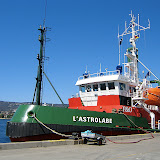
I have been told that the first trips of the year, usually end of October, are the most spectacular. The Astrolabe (the ice-capable ship used to reach Dumont from Hobart in Australia) has to navigate between plates of sea-ice, and some years cannot get to the base itself. In these cases, if the ice-pack is not too wide, people and light cargo is ferried over to Dumont by helicopter. Sometimes the ice-pack is too wide, and the ship has to turn around and go back.

The crossing my colleague JY and I are booked on is due to sail from Hobart on December 28th. We will most likely reach Dumont on the 1st or 2nd of January, at the height of the Antarctic summer. Our chances of finding sea-ice are minimal, but we may if we are lucky get good views of the larger icebergs that will not have drifted too far or melted too much by that time. I am very much looking forward to that!

Monday, November 5, 2007

Antarctica Earthquake : M 5.8 "Casey"


Updated post.

There has been a large earthquake on the Antarctic continent. The USGS report gives the following updated details:

Magnitude 5.6
Sunday, November 04, 2007 at 20:35:36 UTC
Location 67.097°S, 111.316°E
Depth 10 km
Region ANTARCTICA
Distances 95 km SSE of Casey Station, Antarctica

Earthquakes on the Antarctic continent itself are extremely rare. This one is likely to be closely scrutinized by all Antarctic seismologists. Here is a Google Earth picture of the know seismicity in the region around the CASY seismic station at Casey (thanks to JJL for the script used to make this image). The image includes the latest event (left-most on the map).


Here are a couple of pictures of seismograms from CASY station. The first shows the three components of motion (vertical, north, east) for the M5.6 event. The strongest signals are saturated. The second picture shows vertical component recordings of a set of aftershocks of the main event. Although we do not have exact locations of these aftershocks, they occurred at approximately the same distance from CASY as the main event.


-----
Keep up to date with the latest developments at http://sismordia.blogspot.com

Tuesday, October 23, 2007

Antarctica Seabed - the saga continues

After the recent hullabaloo about Britain's submission to the UN Commission on the Limits of the Continental Shelf regarding the seabed attached to its frozen territorial claim in Antarctica, Argentina and Chile have joined the throng (see articles here and here).

It is not surprising that all countries with frozen territorial claims in Antarctica are soliciting the UN-CLCS. The fact that there is a deadline imposed on submissions to the commission leads naturally to a concentration of submissions close to this deadline. In my previous post, I stated that this deadline was fixed at 10 years after the country concerned had signed the Convention on the Law of the Sea (Article 4 of Annexe II of the convention). The articles cited above, however, state that this deadline is in 2009. Why the discrepancy? Quite simply I got my deadlines mixed up (mea culpa!). It seems that the 10-year time-limit had raised many issues with countries unable, often for legitimate reasons, to file their submissions in time, and was therefore modified by the following decision:

The decision provides that, for a State for which the Convention entered into force before 13 May 1999, the date of commencement of the 10-year time period for making submissions to the Commission is 13 May 1999.
You can read more about the details and history of this decision on this CLCS page.

Given the 2009 deadline, both Chile and Argentina are well within their rights in submitting their own claims to the Antarctic seabed. None of these claims should actively be considered by the CLCS while the Antarctic Treaty is in force. Should the time come, any decision on the British, Chilean and Argentinian claims will most probably be dependent on resolution of their overlapping claims to the Antarctic continent itself.


-----
Keep up to date with the latest developments at http://sismordia.blogspot.com

Saturday, October 20, 2007

Who owns Antarctica?

Update: since writing this post, Chile and Argentina have reacted to the British submission to th UN Commission on the Limits of the Continental Shelf by announcing they will file their own claims. Read all about it in this follow-up post.

Who owns Antarctica?


This question is one of many Antarctica-related questions my colleagues and I asked visitors to our International Polar Year stand at the recent Science Fair (Fete de la Science) held last weekend. It was of course a trick question, because no-one owns Antarctica. All territorial claims were frozen by the Antarctic Treaty, which guaranteed the continued use of Antarctica exclusively for peaceful ventures, and the freedom of scientific investigation and cooperation in Antarctica.

So imagine my surprise the following Wednesday, when this article from the Guardian newspaper appeared: Britain to claim more than 1m sq km of Antarctica - Move would extend UK oil, gas and mineral rights.

Here are some quotes from the article (ellipses are my own):

The United Kingdom is planning to claim sovereign rights over a vast area of the remote seabed off Antarctica [...] The submission to the United Nations covers more than 1m sq km (386,000 sq miles) of seabed, and is likely to signal a quickening of the race for territory around the south pole [...]

The claim would be in defiance of the spirit of the 1959 Antarctic treaty, to which the UK is a signatory. It specifically states that no new claims shall be asserted on the continent [...]

The Foreign Office [...] has told the Guardian that data is being gathered and processed for a submission to the UN which could extend British oil, gas and mineral exploitation rights up to 350 miles offshore into the Southern Ocean. [...]

The Antarctic submission reflects the UK's efforts to secure resources for the future as oil and natural gas reserves dwindle over the coming decades[...]

The article raised two troubling questions in my mind: how is such a claim compatible with the Antarctic Treaty System? and is the Antarctic seabed legally exploitable? Before getting onto my high horse about this claim, I needed to look more closely into the Antarctic Treaty itself. The best source of information I could find was the Antarctic Treaty Secretariat, where I re-discovered most of the facts described below.

The Antarctic Treaty deals with the issue of sovereignty in Article IV, essentially maintaining the status quo of 1959 with regards to territorial claims and their recognition :
No acts or activities taking place while the present Treaty is in force shall constitute a basis for assenting, supporting or denying a claim to territorial sovereignty in Antarctica or create any rights of sovereignty in Antarctica. No new claim, or enlargement of an existing claim [...] shall be asserted while the present Treaty is in force.

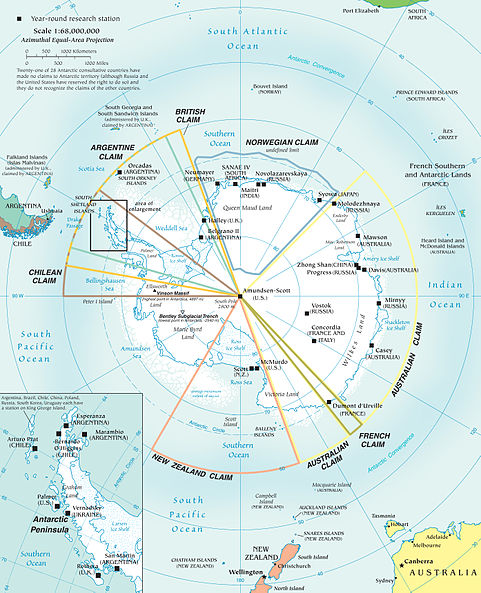
Note that the Treaty does not require the countries with territorial claims made before signature of the Treaty to renounce them. The British, Australian, New-Zealand, French, Argentinian, Chilean and Norwegian claims were therefore frozen in 1959. [Note that to further complicate matters, the Argentinian and Chilean claims overlap with the British claim].

If no new territorial claims can be made or extended, what is this possible submission to the UN by the United Kingdom about? The submission would be to the UN Commission on the Limits of the Continental Shelf (CLCS). This commission judges claims on the limits of a country's continental shelf, which in turn affect the definition of its territorial waters. According to the Convention on the Law of the Sea (CLOS), claims to the CLCS should be submitted within 10 years of its entry into force for that country. As the UK signed the convention in 1997, should it wish to submit any claims, it should do so before the end of 2007. Hence the submission described by the Guardian article.

Something that was not mentioned in the Guardian article, but was brought to my attention by the Antarctic Treaty Secretariat site, was that Australia and New Zealand both submitted similar claims regarding the continental shelf adjacent to the regions of Antarctica over which they held territorial claims before 1959. The Australian claim was submitted in 2004 (Australia signed the Law of the Sea in 1994), while the New Zealand claim was submitted in 2006 (New Zealand signed the Law of the Sea in 1996).

In order to allay any concerns about the Antarctic Treaty, Australia requested that the CLCS not take any action for the time being on its Antarctic claim. The Guardian suggests the UK should make a similar request:
Ministers will have to decide under what terms the application to the UN would be made. One possibility might be for the UK government to lodge a legal claim with the UN's commission on the limits of the continental shelf and effectively park it for consideration at a future date.
As for any remaining environmental concern about future drilling off the coastal waters of Antarctica, the Protocol on Environmental Protection, an addition to the Antarctic Treaty, specifically prohibits all activities relating to the Antarctic mineral resources except for scientific research (Article 7).


What are my conclusions after all this? Firstly, that as far as I can see the UK will be doing nothing illegal or morally wrong by submitting its claim to the UN, though it will most probably have to find an agreement with Argentina and Chile given their overlapping claims to Antarctica. Secondly, and more importantly, that at some time in the future, and preferably within the next 20 years, it will be necessary for the international community to put some order into its conventions and treaties, and to decide how it intends to balance national interests with environmental issues.


Update: since writing this post, the following posts/articles have come to my attention:

-----
Keep up to date with the latest developments at http://sismordia.blogspot.com

Thursday, September 13, 2007

Antarctic blog posts review #3

If you've been wondering why it's been so long since my last blog post review, I can give two reasons: not that many Antarctic posts, and not much free time for blogging (ok, I'll be honest, my main reason is the second one: I've been maxing out on work lately, trying to get the equipment needed for this summer's Antarctic campaign ready - more on that in a later post).

Here are two of my favourite recent posts from the nether regions of the world:

Escape from Station
Z-Doc does it again, with a beautifully crafted photo-post.  With the return of sunlight, the intrepid over-winterers now have a chance to get out and about.  And for those lucky enough to be living close to Emperor Penguin colonies, the photo opportunities are far from scarce, though not always easy (skidoos and the cold often do not agree too well).

The Bivvy
Just in case you were not convinced of the craziness of some of the guys and gals who chose to spend a year freezing their extremities off in Antarctica, come read how a group of crazies decided to sleep outside in -40 degrees... for fun.

-----
Keep up to date with the latest developments at http://sismordia.blogspot.com

Sunday, August 26, 2007

Antarctic winter - the end begins

Two weeks ago we started to have sun-up at some coastal Antarctic stations, an event which led to a few posts from Antarctic bloggers summarized in my first and second blog post reviews (you can find the original posts here and here and here).

This week, posting has been rather slow, something I ascribe to the preparations for the end of isolation at the bases. In fact, this week both Scott and McMurdo base have been visited by their first flights of the season. This is an occasion for celebration after 6 months of darkness and isolation.

From the 70South article on Scott Base, it seems fresh food is top of the agenda:

Finally, the six months of isolation have come to an end for the 20 staff who are stationed at New Zealand's Scott Base. After such a long time, the supply of fresh fruit and vegetables have long since been consumed.

However, they will still have to be patient a little bit longer as fruit and vegetables are not due to arrive till Friday. When asked to fill out a wish list, the requests were very varied, from raw carrots to crumpets or melons

At McMurdo too, food and external human contact are top of the agenda, according to 70South.

The scientists and other personnel from the American McMurdo Station have been longing for this. Finally, after five and a half months of isolation during the Antarctic winter, the first plane flew in with fresh supplies and passengers.

[...]

“We bring people down that will begin construction on what is called the annual sea ice runway,” Lt. Col. Jim McGann, 304th Expeditionary Airlift Squadron commander, said in the release.

With all this ado, it is not surprising that writing blog posts is not really the highest priority out there right now. I hope to be able to report about our intrepid bloggers' reactions soon. In the meantime, thoughts and best wishes to all of them, be they out of isolation or still waiting for that first human contact to end the long winter.


-----
Keep up to date with the latest developments at http://sismordia.blogspot.com

Thursday, August 23, 2007

Antarctica - The Global Warning

Antarctica - The Global Warning, a award winning photographic book by Sebastian Copeland, is now available online. The website offers a short video tour of the book with an interview of the author, a photo-gallery, and images you can download for your own desktop.

Here are two of the images you can download:


The book itself, priced at $55.00 on Earth Aware Editions, will be available for purchase starting on September 17th.

Disclaimer: I have no direct or indirect connection with either Sebastian Copeland or Earth Aware Editions. I am plugging this book only because I think the photographs are great.

-----
Keep up to date with the latest developments at http://sismordia.blogspot.com

Sunday, August 19, 2007

Antarctic history revealed by shear wave splitting

Blogging on Peer-Reviewed Research
Antarctica is a patchwork of different blocs, which have come together and split apart a number of times before forming the continent as we know it today. The history of this coming and going is written in the fabric of the Antarctic lithosphere, and can be read using standard seismological techniques.

One such technique is shear wave splitting, the investigation of shear wave birefringence through the upper mantle that has been rendered anisotropic by the accumulated effect of millions of years of tectonic processes. By measuring the anisotropy via shear wave splitting, we can attempt to unravel this tectonic history.

Bayer et al. (2007) present results of shear wave splitting measurements carried out on permanent and temporary seismic stations in Dronning Maud Land, Antarctica. They show that the anisotropy varies strongly with position, indicating the presence of distinct lithospheric blocs, separated by a suture that probably cuts through the whole lithosphere.

The anisotropy they find is not consistent with current plate motion, but in general follows the strike of magnetic anomalies, indicating that the crust and mantle were strongly coupled during the major tectonic episodes by which the Antarctic continent was assembled.

At near coastal stations this study agrees with previous research in finding evidence for two superposed layers of seismic anisotropy. The upper layer is consistent with local crustal magnetic anomalies. The lower layer is consistent with the first rifting stages of the Gondwana super-continent, when South Africa separated from the Antarctic continent.

In short, the seismic anisotropy found by shear wave splitting in Donning Maud Land strongly supports a succession of continental collisions, lithospheric extension and fragmentation. As the seismic experiments planned for the International Polar Year take place, there will be data from more locations in Antarctica, and more of the jigsaw puzzle of this frozen continent will fall into place.

References

Bayer, B., Muller, C., Eaton, D.W., Jokat, W. (2007). Seismic anisotropy beneath Dronning Maud Land, Antarctica, revealed by shear wave splitting. Geophysical Journal International, 171(1), 339-351. DOI: 10.1111/j.1365-246X.2007.03519.x

-----
Keep up to date with the latest developments at http://sismordia.blogspot.com

Saturday, August 18, 2007

Antarctic blog posts review #2

The topic for this week's Antarctic blog posts review is sun-up. Yep, the sun is now up at most Antarctic bases, really up, visible above the horizon and all...

Returning light
Light is indeed back at Scott Base, but the weather is not being cooperative. They have been hit recently by a spell of Condition 1 weather (i.e. storms that make it dangerous to be outdoors). Apparently, others have been hard hit by the storm too:

Up at McMurdo the blizzard scattered equipment, turned over vehicles and tore a chunk off the edge of one of the accommodation blocks.
Just a reminder that the environment can get harsh out there!

Sun up, getting plastered, Action Film Party
Julius over at Halley is back with a new post about the re-plastering of his broken leg (read about the breaking of said leg in my previous blog posts review), the return of the sun, and an action-film themed birthday party.

Julius seems fine after his leg-breaking adventure, and is working hard. Reading his post, I found out about the Halley sun-up ceremony, in which the youngest person on the base raises a new flag, which will stay up until it is shred to bits by the wind. I wonder what if any sun-up ceremonies are traditional at other bases...

-----
Keep up to date with the latest developments at http://sismordia.blogspot.com

Overwintering in Antarctica - good for one's health?

Blogging on Peer-Reviewed ResearchIt has always seemed to me that overwintering in Antarctica would be a fascinating experience, albeit not one I would engage in lightly if at all. I would not consider myself psychologically stable enough to endure the isolation. In any case, I would never have thought it could be beneficial to one's psychological health.

This article in Le Figaro online (which I only found thanks to a reference in a mountaineering blog of all places) refers to a recent article in The Lancet (Palinkas & Suedfeld, 2007) on the subject of the consequences of living for long periods of time in the polar regions.

It seems from this study, which includes amongst other measures of "health" the examination of diaries or logs written by the overwintering team themselves, that the physiological and psychological reactions to the environment are by no means only detrimental.

Of course there is an increased risk of accidents tied the the climactic conditions, and also some derailment of thyroid function and of the internal body clock. These last tend to cause perturbed sleep patterns, a loss of intellectual prowess and memory, and increased irritability that can lead to tensions and conflicts, all of which can cause depression.

However, the authors of the study underline that there are also positive side effects, notably the joy and self confidence that are a direct consequence of living in these difficult conditions and surmounting the difficulties as they come. The authors also found in the diaries many references to the beauty and grandeur of the environment, to the camaraderie and support of the entire team, and to the strong emotions generated by facing and surmounting the challenges the environment brings. It is also significant that many of those who overwinter once in Antarctica, apply to do so again.

All this rings true to me, although I have not, and probably never will, overwinter anywhere. Not only because I have been reading a number of web-logs of current and past overwinterers, but also because I have felt the same emotions myself, the same camaraderie, joy and self confidence, during summer campaigns in the sub-Antarctic. There is a saying in our group at the lab :

"The more difficult the campaign is, the better the memories when you surmount the difficulties, and the sooner you want to go back!."


References

L. Palinkas & P. Suedfeld, 2007. Psychological effects of polar expeditions, The Lancet, DOI:10.1016/S0140-6736(07)61056-3


-----
Keep up to date with the latest developments at http://sismordia.blogspot.com

Friday, August 10, 2007

Antarctic blog posts review #1

One of the best ways to learn about what life is like in Antarctica is to regularly browse blogs written by those who are currently out there. A number of these blogs are listed in the Antarctic Blogs of Note panel on my side-bar.

Some of the posts on these blogs are brilliant, and deserve to be shared. I have done so in the past by short posts of my own (see Midwinter: a great post from Halley, and McMurdo Blue Moon Run).

I would now like to try out a new format: a semi-regular blog post review, in which you will find short summaries of and links to recent Antarctic Blog posts that have interested me the most. So here goes:

The returning sun (when exactly is it going to happen?). I break my leg.
Julius over at Halley writes about waiting for the sun to re-appear (apparently it should rise for the first time on August 11th) :
I know from last year that as soon as the sun reappears you wish that it would go away because it is so bright that you have to immediately wear sunglasses.
Julius then goes on to recount his latest kiting escapade (kiting = skiing or snowboarding while being pulled along/up by a large kite), in which by a stroke of bad luck he ends up breaking his leg: Julius's leg is now in plaster, courtesy of Richard the Halley doctor, and he will now have to take it easy for a while. Amazingly, he seems pretty upbeat about it all:
Its not the greatest of things but it happens. I should hopefully have more time on my hands to keep you updated.
Best wishes Julius, and get better soon!


Et lux in tenebris lucet
Z-Doc, again over at Halley, has written a great post with many fantastic pictures of the return of sunlight at the base. Each picture has a detailed and informative description. Here is an example:
The winds settled and the thick layer of low cloud peeled back to reveal the beautiful 'mackerel skin' rippled appearance of altocumulus that makes the most beautiful skies; with it came light that has been so lacking for the last few months.
The post covers the arrival of light in the darkness (as by its title), but also kite-skiing and the daily task of launching of meteorological balloons, all illustrated by top-notch photographs. Well worth a read.


Celebrating the new bar
Phil, over at Scott Base, has written about the inauguration of their new bar, which is the social center of the whole base:
The refurbishment of the bar and lounge, which could be considered the centre of the base has been well worth the wait.
Worth a read for the pictures of the bar itself: what luxury! I wish we had something similar at our lab...


That all for this edition of the review. If you know of any posts or other Antarctic blogs that you think I should take a look at, please let me know.

-----
Keep up to date with the latest developments at http://sismordia.blogspot.com