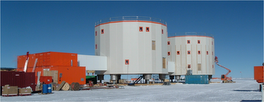
Showing posts with label Dumont d'Urville. Show all posts

Monday, February 11, 2008

Departure from DDU

Last half-day at DDU...

We are expected to be on board the Astrolabe this afternoon, as our departure is set for early evening. Six days at sea await us... what a glorious prospect...

The day is bright and windy, which makes for great visibility, but choppy waters. The numerous icebergs that in the bay at the moment will escort us out to the open sea. I shall be sad to say goodbye to these ice-monsters.

Goodbye Dumont d'Urville, goodbye Antarctica! I hope to be back soon...

Thursday, February 7, 2008

Spot the birdie...

The sun is back, and with it the possibility to escape Dumont d'Urville base for a few hours. Today JY and I tagged along with two friendly ornithologists who had work to do on Lamarck island. We helped them count Adélie chicks, and put id tags on Snow Petrel and Cape Petrel chicks. The Snow Petrel nests are particularly difficult to find, as these birds hide in crevices in the rocks. We spent a very pleasant morning clambering over the island looking for them.

One thing I learned about Petrel chicks of both species is they projectile vomit in self-defense. Our friendly ornithologists got covered in the stuff, with one receiving a direct hit in the face... yum. My job was to help locate nests and write down the tag numbers. Even though I did not have to reach into the rocks to extract the chicks (I would not have known how to do so without hurting them) I still managed to get vomited upon.

Other notable events today: first sighting of Emperor Penguins in the archipelago and a partial solar eclipse.

Tuesday, February 5, 2008

The Astrolabe is back

The sun that bathed us most generously over the weekend (the photo above was taken last Sunday) has given way to two days of wind and snow. There has been so much cloud that at times we could hardly see over to the next building, let alone make out the continent or the icebergs in the bay.

The Astrolabe arrived offshore early this morning, but did not dare come into dock in such windy conditions with near zero visibility. It waited until early afternoon for the snow storm to clear, then gingerly inched onto the bay and to its mooring. It should stay here five days or so, time enough to unload its cargo (mostly fuel for the winter) and pick up its forty odd passengers (I shall be one of them) for the crossing over to Hobart.

If all goes as planned, I should be leaving here this coming Sunday or Monday. Although the prospect of a 5-7 day crossing through rough seas the flat-bottomed Astrolabe doesn't really fill me with anticipatory joy, I shall be glad to be on my way home at last.

Sunday, February 3, 2008

Adélie chicks

Petrel Island and Dumont d'Urville itself are home to a vast colony of Adélie penguins. They are everywhere, on every scrap of rock. They are cute little critters, once you get used to their smell and raucous calls. Many an hour can be whiled away by watching their comic antics, as they come and go from the sea, steal stones from each other's nests and feed their young.

The Dumont d'Urville colony has been under continuous study for a number of decades, and there is at least one marine ornithologist at the base at all times. Today, JY and I volunteered to help weigh some of the Adélie chicks born to the one hundred couples under study this year. Together with the resident ornithologist, we tracked down the correct chicks among the rocks, weighed them, measured the length of their right aileron, and removed their identification tags.

The chicks were all between 42 and 45 days old, weighed between 3 and 4 kilograms each, and had started to shed their downy fur for more sea-worthy feathers. They will soon complete their transformation and take to the sea for the winter. The chick I am carrying in the photo was, at 2.75 kg, the smallest one we weighed today, and still had all of its down. It was very placid and soft to the touch: a pleasure to hold

Saturday, February 2, 2008

Prawn cocktail anyone?


Another beautiful day on Petrel Island, and another fishing trip, far more successful than the last one I described. Part of this morning's catch is shown in the photo above.

The spot we went to was the same as the one we visited two days ago, but the ice scenery was entirely different. In two days most of the bergs had drifted to new positions. Some of the larger tabular ones had lost parts of themselves through calving, and one of them had flipped on its side. We just missed seeing a large chunk calve off a tabular berg. We heard it though, and saw the resulting wave and ice-debris: impressive!

Friday, February 1, 2008

Community life...

One of the pleasures of living the Dumont d'Urville life is being on cleanup detail every now and again. This detail includes laying the tables, serving, clearing and washing up after three meals, as well as cleaning all communal living areas. Three people are assigned to this detail every day, with one of the three on lighter "backup" duty.

I was "backup" in today's cleanup detail. In order to avoid what I consider to be the worst aspects of the job (floor and toilet duty) I volunteered from the start to do all the washing up. I had already had some experience at washing up efficiently for this number of people atConcordia, where I was on "dishes detail" twice in two weeks (the second time was the day I left - the last thing I did at Concordia was wash dishes...).

For my family and others who know me well and may have trouble believing I could wash up three times a day for sixty people, the photo above should serve as proof...

Thursday, January 31, 2008

Fishing expedition

Sunshine makes a world of difference! Today we finally had blue skies again, after nearly a week of cloud, wind and snow, so we celebrated by going on what was supposed to be a photo-tour. The first stop on our tour was the quay, from which we had planned to start circum-walking the island, keeping as close to the water and sea-ice as possible, so as to get good pictures of penguins, seals and aesthetically pleasing ice formations.

Instead we found a group of "ornithologists" preparing for a fishing expedition (actually marine biologists, not bird experts, but any life-scientist seems to be called an ornithologist here). They promptly invited us to join them. After dropping a cage for catching crustaceans in the open waters of the bay, we navigated to a quiet spot sheltered by icebergs, and started dredging the bottom of the bay for whatever happened to live there.

We managed three runs before the hydraulics powering the winch broke down, and we were forced to raise the last dredge-pan by hand. While the marine scientists and JY had fun poking around in buckets filled with odd, spindly, spiky, gooey marine creatures (not really my kind of thing), I spent time taking in the spectacle of icebergs at close quarters.

They are a magnificent sight, glistening in the sunlight, changing color and shape depending on which angle you view them from. Some have had caves excavated in them by waves, others have been sculpted into soft shapes by wind and water. Yet others are tabular, and in the right light you can see they are stratified like sedimentary rocks (the "sedimentation" is actually snow accumulation) and traversed by fault-lines and crevasses.

It was cold on the water despite the sunshine. We had not expected to be taken fishing and had not dressed accordingly... However, the opportunity to spend time close to those fascinating ice-monsters was well worth it!

Wednesday, January 30, 2008

Snow!

The wind is dying down, it no longer buffets us as strongly. Walking has become easier, and it is even possible to find the odd place where the air is almost still. Such spots are great favorites with the amateur photographers of the base, as the views onto the Antarctic continent can be spectacular.

Can be. The continent, although it is distant no more than a couple of kilometers, is not always visible. Today it is hiding... It has been snowing since this morning, small unstructured flakes whirling around in the diminishing wind, gently coating the whole base in a mantle of whiteness, and hiding the continent from view. It is the first time I have seen it snow since arriving in Antarctica.

In Concordia it hardly ever snows. We experienced winds that lifted the surface snow into a blizzard, reducing visibility to a few meters, and creating artistic snow drifts, but no real precipitation. The annual accumulation up there is around two centimeters a year... dryer than many deserts!

Here at sea-level there is more humidity in the air, more weather-related phenomena, and more snow... The past few days, the opportunities for photography have been a little scarce, because of the winds and now the snow. The photo above was taken a few days ago by JY, when we went out onto the sea-ice to visit the seals. Cute and cuddly... ahem... so long as you don't get too close...

Tuesday, January 29, 2008

Electricity

Shocks from static electricity are something we all experience everywhere.

Just shuffle your rubber-soled shoes against the carpet on a dry day and you can be sure to get a spark from the next metal object you touch. Over here in Dumont d'Urville it takes very little indeed to provoke a spark of static electricity.

Every time I take my fleece jacket off, or pull on my woolly hat, I knowI'm charging myself up. Every time I put out my hand to a door handle a spark goes off. Some parts of the base are worse than others. I have not yet managed to enter the far side of the meteorological building without getting a jolt off its door. In Concordia it was even worse than it is here: I would get a spark of the door handle at the bottom of the stairs, only to get another one off the other door handle at the top.

Sparks of this kind can be quite dangerous for computers and other electronic equipment. Everyone has stories of having killed one machine or another via a particularly nasty jolt of static. So we take precautions, and usually try to discharge ourselves against a metal door or wall before touching anything sensitive. I used to find it odd to watch people knock against metal surfaces before reaching out their hand. Now I fiind myself doing the same... a shock off a knuckle is not nearly as annoying as one off the fiingers!

As the saying goes, when in Rome...


Monday, January 28, 2008

Windy weather

All it takes is a depression off the coast somewhere...

It has been windy ever since I set foot in Dumont d'Urville, normal, every-day wind of the "hold on to your cap" variety. Last night the wind got bored of being so reasonable and started blowing more convincingly. It has been increasing in strength throughout the night, and is now blowing a pretty decent gale, with peak speeds of 140 km/h.

Its roar is present everywhere, changing in tonality and volume depending on the building one happens to be standing in at the time. The buildings themselves rattle, creak and moan as the gusts blow over them. Sometimes a particularly violent gust whistles through a badly insulated opening, causing a temporary increase in air pressure that is felt by the eardrums, and makes everyone wince.

The sea is whipped to a frenzy of white-tops whose froth is launched upwards by the gusts. This is not a sea I would like to experience in the Astrolabe! The spray is thrown easily up and over the smaller icebergs in the bay. The larger bergs act as windshields, but are themselves slowly displaced by the moving air.

When we move about the base, we walk with bent knees, trying to keep as low a profile as possible. We are told to avoid running along the metal walkways that join the buildings, as a gust of wind can easily pick a person up in mid-stride. The Italia Antartide cap I have been wearing for the past few days has given way to the IPEV standard issue woolly hat, which fiits snuggly around the ears and is less susceptible to being blown off my head.

The meteorologists on the base tell us this weather should last another few days, until late Wednesday or early Thursday at least. Winds like these are apparently pretty common here in Terre Adélie... so I guess I'll end up getting used to being buffeted around whenever I venture outdoors..

Sunday, January 27, 2008

Sunday tour

Today is Sunday, a day for lie-ins and laundary, "brioche" at breakfast and fruit tart at lunch. After lunch I went on a tour of the base with T, who will be in charge of the power station over the winter. Of course, the tour started with the power station itself...

There are four electricity generators here at Dumont, three in the main power station and an emergency one in another building. Of the three generators, only one is sufficient for the needs of the base, the other two are for backup. These are rather modern machines, which according to T give no problem at all.

Water production, however, is a different matter. The system is ingenious, but highly non-standard, and is 18 years old. Essentially, seawater pumped from the base of the island is boiled under vacuum using the heat from the electricity generators, then condensed around pipes cooled by more seawater, and collected. It is then cleaned and re-mineralised to become drinking water.

The warm seawater left over from this process is used to heat all the fresh-water pipes so they don't freeze in the winter. There is no electronics in the system, so all the pressure regulation is done by hand, through opening and closing valves. There is someone from the technical team in the power station at all times, day and night. These guys are the unsung heroes of the base...

Today's tour also took me to the first building constructed on the island, Marret Base which was repaired and renovated 22 years ago. From the outside it looks nothing special, but inside it is easily the warmest and most comfortable looking structure on the whole base, as it is the only one built almost entirely out of wood (see photo).

Saturday, January 26, 2008

Seals on sea ice

It is the end of the summer, and the sea-ice surrounding Dumont d'Urville is nearly all gone. Just enough remains, however, for a quick trip to visit the local seal population. JY and I went this morning, stepping very gingerly to keep our footing on the slippery surface and taking care not to wander too close to the water or onto thin ice.

There was a large group of seals some way away, but the ice looked too watery there to be safe for us. Instead we approached an isolated seal lying in the sun on thicker ice, warming itself and digesting its most recent meal. Although it had a very sweet face, and seemed to have a quiet disposition, I was vary wary of getting too close. The photo shows how close I did get...

Friday, January 25, 2008

Dumont d'Urville, tourist destination?

Dumont d'Urville - referred to as "Dumont", "Durville" or "DDU" for short - is a relatively old scientific base. It is perched atop rocky Petrel Island, just off the Antarctic continent, and is home to resident colonies of Snow Petrels and Adélie penguins as well as to a few dozen scientists and logistics personnel.

It is made up of a few weather-worn, reddish, prefabricated buildings connected by metal walkways. We have dormitories, various science labs, a central living/dining building, a post-office, a meteorological station, a power station, and a couple of sculptures, one of which is of Mr Dumont d'Urville himself.

The sky is grey overhead today, the wind has picked up, and there is a little snow. The cold is nowhere near as intense as it was at Dome C, but it feels colder due the higher humidity level at sea-level. Since coming down here from Concordia I have been frustrated... there was so much to be done up there, and so little to be usefully done here. It feels like I'm on a forced vacation... Ugh!

Personally, Dumont d'Urville is not a place I would choose to go on holiday. When I need to relax, chill out, indulge my desire to do nothing at all, I tend to choose warmer, sunnier spots than this. I was surprised to discover upon arriving here that Dumont is in fact a tourist destination. This week alone, two tourist ships have dropped in for a visit, sending their passengers ashore for a quick tour of the base. Today's ship carries 100 tourists from New-Zealand. They come ashore in small groups, and are shown around by the resident scientists (see photo above). They are shown some of the labs, the living area (where they are offered a hot drink and biscuits), the Post Office (for post-cards and special Antarctic stamps that are much sought after by collectors), and the office of the "Chef de District" where they can purchase other souvenirs.

Antarctic tourism is a booming business, as many of the more accessible bases in the Antarctic peninsula can attest too. Tourists pay a great deal of money to set foot on the continent, take photographs of penguins, talk to us campaigners. Although it rankles to see a scientific base invaded in this manner, I cannot be annoyed at the tourists themselves. The fascination of living an "Antarctic experience" can be extremely powerful. This fascination was part of the reason I jumped at the opportunity of working here in the fiirst place, and undoubtedly motivated the fiirst steps of many campaigners and winterers before me. There is, however, something deeply displeasing about the concept of tour operators making money out of the vision, tenacity and hard work of many generations of scientists and dedicated Antarctic support personnel.

P.S. I apologise for the low resolution of the photos on my posts from Dumont d'Urville. I am limited by a very severe quota on email attachments (30kb), and cannot send posts other than via an email-to-blog system.

Thursday, January 24, 2008

Goodbye Concordia

The Concordia chapter of this Antarctic adventure is now over, and we are back in the more moderate climate of coastal Antarctica. The photo above was taken at around 4am local time, as we came in to land at D10, the landing strip on the plateau that serves as the Dumont d'Urville airport.

Leaving Concordia was hard for me to do. There was a strong community spirit which I shall miss. Life was by no means easy up there, between the cold, the altitude and the spartan living/working conditions, but these difficulties created strong ties between us all. At Concordia it is natural to help each other out whenever possible, as you never know when you'll need help yourself. Of course, some people are more generous with their time and energy than others, but for the most part you barely need ask to receive the help you need.

Our continuously advancing departure date, and the ensuing rush to get everthing finished on time, made it hard for me to savour the last couple of days up there. We were being pushed out of the door, forcibly ejected not by the people at the base themselves, but by logistical necessities that were beyond our control. Intangibles such as community sprit and friendships grown out of shared hardships could be given but little consideration.

All too soon we were climbing into the Twin Otter for our flight back, having barely had time for rushed goodbyes to the thirteen winterers and the few remaining summer campaigners. A chapter was closing, too fast and suddenly for my liking. I do not believe I was the only one who got a little emotional as the plane taxied off...

The flight to the coast lasted five hours, during which it was hard to sleep (Twin Otters are not the most comfortable or quiet of aircraft). We saw the moon again for the first time in weeks. Indeed we saw it for most of the journey, as our route from Concordia to Dumont d'Urville lay almost due North. The coastline itself was beautiful in the soft early morning light, albeit with much less ice and many fewer bergs than when we had set out two weeks ago.

The ice will return as winter sets in, though I shall no longer be here to see it. JY and I are due to leave on the next rotation of the Astrolabe, in approximatelly two weeks' time. Until then our new base will be Dumont d'Urville, with its coastline, its icebergs, and its colony of (noisy and smelly) resident Adélie penguins.

Monday, January 7, 2008

Still at Dumont...

Did I write something yesterday about plans only being made so they could be changed? No truer word was ever written...

With all nine passengers of the first twin otter flight suited up in polar gear and raring to go, and indeed the first four already being heliported to the airstrip, the flight was cancelled: the pilot could no longer fly that day.

We all dragged ourselves back indoors on the Astrolabe, peeled off our multiple thermal layers, and slumped down in a heap of thwarted adrenaline. We soon got over it, though: these things are pretty typical out here.

The upside of it is, we get to spend more time gawping at penguins. The downside is the weather seems to be changing, and not for the better. I hope we have not missed our best chance at getting to Concordia early.

If our luck does hold, my next post will be from there.

Sunday, January 6, 2008

Change of plans - Concordia is for today

Some things remain the same in all Antarctic expeditions: plans are made to be changed. Our flight to Concordia has been brought forward to today. We leave in 30 minutes time.

This morning we went through the pre-flight ritual of packing and weighing both ourselves and our luggage. We can take only the bare essentials with us this afternoon, the rest will follow in a couple of days time.

We made good use of the four hours we had left by crossing to Dumont d'Urville over what little is left of the ice-pack, visiting the station, and purchasing a stock of postcards and stamps that will keep us occupied in the evenings at Concordia (there is no Post Office up there).

The weather is amazing: sunny, warm (0.4C in the shade), not a cloud in the sky. Good weather for spotting and photographing Adelie penguins, Emperor penguins and snow petrels... the last non-human creatures we shall see for a while (there is neither flora nor fauna up at Dome C).

The adventure continues at full steam. Next post from Concordia!

Saturday, January 5, 2008

Midnight arrival at Dumont d'Urville

It is a quarter to midnight local time (GMT+9), the sky is light, the penguins are active, and we are finally moored opposite Dumont d'Urville station.

It has been a day of ice. Big tabular bergs floating by, the Astrolabe bumping through unconsolidated pack, forcing its way though thicker but still not solid pack, us taking photographs from all angles and in all light conditions. More often than not it felt like being in a dream world. A cold one at that.

For the time being we are consigned to the ship. Those whose final stop is Dumont itself will disembark tomorrow. The others (myself included) will continue to bunk on the Astrolabe, and hope to get permission to go ashore and visit the base during the day. This state of affairs should only last a couply of days, as JY and I are scheduled to fly up to Concordia on Tuesday 8th.

Thats all for now... Goodnight from Dumont d'Urville station!

Sunday, December 2, 2007

High Resolution Antarctica Images

There has been a lot of buzz around the web recently about new high resolution imagery of Antarctica, called Landsat Image Mosaic of Antarctica (LIMA). LIMA was created by the U.S. Geological Survey (USGS), the British Antarctic Survey (BAS), and NASA, with funding from the National Science Foundation (NSF). Follow the links to read the official press releases from the USGS, BAS, and NASA.

As an example of the quality of images available from LIMA, here is a false-color map of the region surrounding the French permanent Antarctic station Dumont d'Urville. The false-color map incorporates infrared data, which makes it easier to distinguish between ice and snow. Each pixel in the image represents a 15x15m area.


In this image, South is approximately up. You can see the difference between the glaciers sitting behind Dumont d'Urville, and the sea-ice sitting in front of it. In winter the sea-ice completely shuts off the base from the water. As there is no airfield, just a small landing area for Twin Otters and helicopters, all cargo and most people must get to and from the base by ship. The base is accessible only during the summer months, when the sea-ice retreats.

I have been told that the first trips of the year, usually end of October, are the most spectacular. The Astrolabe (the ice-capable ship used to reach Dumont from Hobart in Australia) has to navigate between plates of sea-ice, and some years cannot get to the base itself. In these cases, if the ice-pack is not too wide, people and light cargo is ferried over to Dumont by helicopter. Sometimes the ice-pack is too wide, and the ship has to turn around and go back.

The crossing my colleague JY and I are booked on is due to sail from Hobart on December 28th. We will most likely reach Dumont on the 1st or 2nd of January, at the height of the Antarctic summer. Our chances of finding sea-ice are minimal, but we may if we are lucky get good views of the larger icebergs that will not have drifted too far or melted too much by that time. I am very much looking forward to that!

Saturday, June 9, 2007

Dumont d'Urville, Astrolabe and Terre Adelie


In the days of wood and sail, getting to Antarctica was an expedition in of itself. The French explorer Dumont d'Urville finally arrived within sight of the Antarctic continent on the 21st January, 1840. He then named the shore Terre Adélie, after his wife. Two ships participated in d'Urville's expedition, the Astrolabe, and the Zélée.

Today, the French scientific base on the Antarctic coast is called Dumont d'Urville, and the land it stands on is still called Terre Adélie. Astrolabe is the name of the ship used by the French polar institute (IPEV) to reach Antarctica.

For the history buffs, this post by Glenn Stein on www.ipy.org goes into great detail about the adventures of Dumont d'Urville.