Showing posts with label Concordia. Show all posts

Thursday, June 5, 2008

Concordia film available from CNRS

During the 2007-2008 summer campaign at Concordia, a team from CNRS-Images filmed a number of the experiments being carried out on the site in the fields of glaciology, astronomy and seismology. The images have now been edited into a 34-minute documentary available directly from CNRS.

The seismology sequences were shot during the field installation of the CASE01 prototype station, and during our descent into the seismic vault (see the Seismology in the Freezer post). Watching the film made the whole experience come back to JY and me very vividly indeed.

The film is entirely in French (no dubbing or subtitles). Here is my translation of the film description:

The French-Italian station Concordia sits in the heart of the Antarctic plateau, on the site of Dome C, and at an altitude of 3233 meters of which more than 3200 meters are made of ice. It is a unique place, totally devoted to sciences. The 3270 meter ice-core project Epica permitted the decryption of up to 800 000 years of past climate. Other activities are in development at the site. The CNRS-Images team has followed the astronomers and the seismologists during their labors. At the start of February, the doors of Concordia will close to the summer technicians and researchers. Only 13 over-winterers will remain, both French and Italian. They will be there almost 10 months, far from everything, out of time, in this world of extremes.

-----
Keep up to date with the latest developments at http://sismordia.blogspot.com

Thursday, January 24, 2008

Goodbye Concordia

The Concordia chapter of this Antarctic adventure is now over, and we are back in the more moderate climate of coastal Antarctica. The photo above was taken at around 4am local time, as we came in to land at D10, the landing strip on the plateau that serves as the Dumont d'Urville airport.

Leaving Concordia was hard for me to do. There was a strong community spirit which I shall miss. Life was by no means easy up there, between the cold, the altitude and the spartan living/working conditions, but these difficulties created strong ties between us all. At Concordia it is natural to help each other out whenever possible, as you never know when you'll need help yourself. Of course, some people are more generous with their time and energy than others, but for the most part you barely need ask to receive the help you need.

Our continuously advancing departure date, and the ensuing rush to get everthing finished on time, made it hard for me to savour the last couple of days up there. We were being pushed out of the door, forcibly ejected not by the people at the base themselves, but by logistical necessities that were beyond our control. Intangibles such as community sprit and friendships grown out of shared hardships could be given but little consideration.

All too soon we were climbing into the Twin Otter for our flight back, having barely had time for rushed goodbyes to the thirteen winterers and the few remaining summer campaigners. A chapter was closing, too fast and suddenly for my liking. I do not believe I was the only one who got a little emotional as the plane taxied off...

The flight to the coast lasted five hours, during which it was hard to sleep (Twin Otters are not the most comfortable or quiet of aircraft). We saw the moon again for the first time in weeks. Indeed we saw it for most of the journey, as our route from Concordia to Dumont d'Urville lay almost due North. The coastline itself was beautiful in the soft early morning light, albeit with much less ice and many fewer bergs than when we had set out two weeks ago.

The ice will return as winter sets in, though I shall no longer be here to see it. JY and I are due to leave on the next rotation of the Astrolabe, in approximatelly two weeks' time. Until then our new base will be Dumont d'Urville, with its coastline, its icebergs, and its colony of (noisy and smelly) resident Adélie penguins.

Wednesday, January 23, 2008

Departure advanced again

Apologies for the short post.

Antarctica being Antarctica and plans being ever variable, our departure has been advanced again. We leave tonight, in 8 hours time.

I'm currently rushing to get everything done that needs to be before getting on the plane.

Next post from Dumont d'Urville.


Tuesday, January 22, 2008

Only 36 hours to go...


The third CASE station is now installed, albeit with a few minor adjustments to the mast caused by an incident involving our trench digging machine (see photo)... what can I say? These things happen in Antarctica! At least the GPS receiver on the top of the mast is still pointing up!

This morning we received news that our flight out of Concordia has been advanced. We leave the day after tomorrow, or in only 36 hours time! It is not unusual that scientific missions like ours get cut short for logistical reasons, but it is always a nuisance.

All in all, this has been a pretty successful mission. Three out of three CASE stations built and installed, and the permanent station put back on its feet. We would have liked to have achieved more, but so goes it.

Tomorrow's will be the last post from Concordia, this outpost in the middle of absolutely nowhere. I have grown quite fond of the place, despite the lack of oxygen, the bitter cold, and the necessary complications of living on an Antarctic base. I shall be sorry to leave.

[Photo credit : Angelo Domesi, who also took the photo on yesterday's post]

Monday, January 21, 2008

CASE-IPY : Second station installed


They have been a long time coming, but now the stations are dropping into place like clockwork. We installed the second one this afternoon, and it only took us three hours from start to finish. Yay!

Our six-person installation team seems to be working well. Not only are we getting the job done, we are also having fun doing it.

We're all a little tired (hence the shortness of this post), but very happy. Two down, one to go. If all goes as planned, the last station will be installed tomorrow afternoon.

Sunday, January 20, 2008

CASE-IPY : First station installed !


It has taken us a lot of time and effort, but the first CASE-IPY station is finally installed. The photo above shows a snapshot of the station as we left it yesterday, and a subset of the installation team (from left to right: myself, Angelo and Claire - JY took the photo).

The seismometer is half a meter down, in between the two flagpoles at the right of the photo. You can see the the mast with the white radio antenna and black solar panels. You can no longer see the two large boxes either side of the mast, holding respectively the acquisition system and the batteries, because they are covered by snow. (If there is one thing that can be said about doing seismology in Antarctica, is that it involves a lot of shoveling snow!)

The funny looking vehicle on the left of the photo is the Flexmobile, with which the 5km journey to the station takes a little over half an hour. I was surprised how un-flat a snow plateau can be. The snow is hard in places and soft in others, making for a very bumpy ride, even in on caterpillar tracks.

Now the first station is installed, the others will follow quickly. The next two stations are scheduled for tomorrow and the day after. That will leave us with three days during which to monitor the stations before we fly back to Dumont d'Urville (our flight is on January 26th).

Time is short, but we are making the most of it...

Friday, January 18, 2008

Germans at Concordia

Last night we all stayed up to wait for a cool plane to arrive at Concordia, a Dakota (DC3) flown by a German crew. The plane is equipped with radar equipment to survey subglacial lakes.

They flew in late last night and flew out again this morning. They are due back again tonight, and will be on base tomorrow. Their headquarters will be the tent attached to our own, so I hope to be able to learn something more about the where and how of Antarctic sub-glacial lakes from them.

Their plane is huge by the standards of the base, lifts up a lot of loose snow and makes a lot of noise. It's a great sight.

Thursday, January 17, 2008

Sock jumping at Concordia

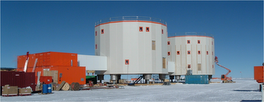
Concordia station is made up of two towers, a "noisy" one that houses the workshops, the power generation units, the restaurant and the living areas, and a "quiet" one that houses the hospital, bedrooms for the winterers and the science labs.

Yesterday we tested the fire escape system of the station, which we all hope will never have to be used in a real fire. It's a cotton and kevlar sock that is deployed from the second floor of the "quiet tower", where the bedrooms are. We all had a turn at jumping through it.

From the top you cannot see the ground, so there is no problem with vertigo. Once inside you press your elbows and knees against the sides of the sock to slow your descent. How slowly you descend depends on how voluminous you can make yourself relative to your weight. Two people at the base of the sock (see photo) twist it to stop those inside hitting the ground too fast.

I jumped in wearing boots and full polar jacket, and had the impression I was not dropping at all, so much so that it got a little claustrophobic. The fastest descender by far was Giorgio the cook, who caught the sock twisters by surprise. Luckily they twisted the end of the sock just in time to stop him hitting the ground like a sack of potatoes. Good thing too, as he is an excellent cook!

All in all, this counts as the most fun fire drill I have ever had.

Wednesday, January 16, 2008

Calcetto or Baby-Foot?


What is your favorite after-dinner activity? Calcetto or Baby-Foot?

Either way, you are bound to be satisfied at Concordia. The living room becomes the scene of two mini-tournaments every day, one after lunch and the other after dinner.

The quality of play is excellent! Italian and French players have very different playing styles and rules. Italians tend to shoot hard and from the far end of the court, while the French tend to dribble the ball and shoot from close to the goal. Here at Concordia the rules are dropped and the styles are mixed, giving rise to quite spectacular play.

I had never thought such a game would make a good spectator sport, but it sure does. The running commentary from both players and spectators is also great fun, especially if you can understand both the more colorful varieties of both French and Italian... It sure beats television (which we don't have) as a way of relaxing after a meal.

In case you were wondering, my own exploits at this game are abysmal. The only thing I can say in my defense - having lost both games I have played - is that I have never lost 10-0...

Tuesday, January 15, 2008

Presenting JY...

It is about time I presented my colleague and co-expeditioner JY, a completely crazy guy (see photo above) with whom it is a pleasure to work.

JY can turn his hand to almost anything, woodwork, metalwork, mechanics, electronics... a great asset out here. I am learning a great deal of practical things working alongside him.

Out here it is important to look out for each other, because minor things can quickly degenerate in these cold conditions. JY is very vigilant on this point, from making sure I don't freeze solid in the seismic vault, to digging my skidoo out of soft snow.

In short, JY is the kind of guy you would want on any field expedition, and I am very happy to have him on mine.

Monday, January 14, 2008

Skidoo time

Today has been great!

We started off by deploying our first complete CASE-IPY station in a test location some 800m from Concordia. The idea was to identify problems with our setup and have time to correct them before our first real deployment next Thursday. We got everything done in record time (3 hours from start to finish) with no major glitches.

This is a test deployment, so we must go back to the installation site regularly over the next couple of days to check the power given by the solar panels and the temperature of our electronics. What a great excuse for skidoo rides!

Skidoos are the best form of short-distance transport out here. Unfortunately the base only has 4 of them for 60 people, and these are always breaking down. Most of the time we go around on foot.

I had never ridden a skidoo before today, nor a jetski or a motorbike, and was rather hesitant at first. However, one trip to our test station was enough to get me in the groove, as you can see by the photo above. I feel I shall be planning a number of such trips in the next few days...

Sunday, January 13, 2008

The seismology tent

I apologize in advance for the shortness of this post. We have been getting all our equipment ready for tomorrow's full scale test installation, and I only have 5 more minutes before the last email connection of the day.

The photo above was taken inside the seismology tent yesterday morning. The stove had gone out overnight (probably due to the wind) and the temperature inside was -16C! Fun for working!

Saturday, January 12, 2008

CASE-IPY : First week at Concordia

Apologies for the lateness of this post. Last night I was too tired to do much more than curl up and go to sleep. Looking over what we have done this past week, it is hardly surprising.

Apart from fixing the permanent station (see previous post), we have completed the setup of the first temporary CASE-IPY station and are now ready for a full-scale test deployment tomorrow (Monday).

Each station is physically composed of three large wooden boxes, containing respectively a seismometer, the acquisition electronics and a battery pack, a 7m mast, a radio antenna and three solar panels. All the boxes are conditioned with multiple layers of insulation to keep their contents as warm as possible. The radio antenna and the three solar panels are attached to the mast.

This past week we have prepared each of these elements so as to have as little fiddling with electrical connections as screws in the field as possible. The few connections that remain to be wired will not be a problem, especially after the experience of working at -59C in the vault earlier this week.

What you see above is the seismometer we will be using tomorrow. We have kept it under snow for the past few days, to get it used to the cold. Yesterday we took it out of its box for the first time and prepared it for use.

Friday, January 11, 2008

Seismology in the freezer

The Concordia seismic station (CCD) has been having a few difficulties lately, which is not surprising given the temperature in the seismic vault is a stable and hideously low -59C. No electro-mechanical system likes working at that kind of temperature, and neither do I.

We have two identical seismometers in the vault. One is heated to a balmy -35C, the other is left cold. A few days ago the heating system stopped working. This sent the "warm" seismometer into a severe drift that drove one of its internal masses to the end of its range. What had been a highly sensitive seismometer was now only a heap of junk metal.

Today, JY and I went down into the seismic vault to localize and fix the problem. The vault is accessed from a shelter (a cabin) a short 1km stroll from Concordia base. At least it is a short stroll in good conditions... in the kind of conditions we had today (28 knot winds blowing snowdrifts everywhere, and a temperature of -30 before wind chill) it was a grueling slog.

Once at the shelter, one opens a trapdoor that leads down to a 45m horizontal snow tunnel. At the end of the tunnel is a short metal ladder, that leads to a longer metal ladder that takes one down to the vault itself. It is bitterly cold beyond the trapdoor, and it only gets worse the deeper into the vault one goes. The air is soon filled with mist from our breath, so visibility quickly becomes poor.

The work we had to do down there included wiring a new power cable for the seismometer heating system, and leveling the seismometer. JY took the cable, I took the seismometer. We were down there around 40 minutes, working often only with thin gloves or bare fingers. At -59C. Excruciating doesn't quite cover it...

But it's over now. The seismometer is working correctly again, and our trip to the vault the stuff of memories. I shall be glad not to have to repeat the operation any time soon!

The photo above shows JY and me just after we opened the cabinet containing the seismometers. It was taken by a CNRS photographer who accompanied us into the vault on an earlier trip this morning to find the cause of the problems. The two instruments are covered by insulation. The "warm" seismometer is on the right.

Photo credits: © CNRS Photothèque - Claude Delhaye.

Thursday, January 10, 2008

All about a stove

For better or for worse, a certain stove - the one that heats the tent we are working in - became the center of attention today. It is an old-fashioned gasoline driven stove which does a remarkable job of heating our 12x6 m steel reinforced tent. For the past two days we have had non-stop wind, which means our poor stove has had a harder time keeping us warm, and we have been migrating closer and closer to it.

Today we had quite an adventure. The chimney of our stove has a wind-stopper that is supposed to pivot when the wind turns. Ours got stuck today, right in the direction of the prevailing wind. Sure enough the wind made it down the chimney and into the stove, creating an enormous cloud of smoke that drove us straight out of the tent (after closing off the fuel first).

One of the maintenance guys at Concordia (his name is Angelo and you can see him in the photograph re-lighting the stove) then climbed onto the roof of our tent to unblock the stopper. Since then, the stove has been working fine, and despite my reservations I have been slowly migrating closer to it again.

There is something so irresistibly attractive about a hot stove in cold weather...

Wednesday, January 9, 2008

Playing in snow

Today we got our first real taste of the cold. So far we have been enjoying moderate summer temperatures of -30C, with little or no wind.

I was surprised at how comfortable such temperatures can be so long as one is sensibly covered up and there is no wind. This morning wind picked up, and though the temperature itself was still only in the low -30s, the wind chill made it seem more like -45C. We found that so long as one keeps moving and doing some form of physical activity, even this is not too bad.

One of the bits of work we had planned for today was learning how to install the 7m masts we will use for our radio transmission, GPS reception and to hang our solar panels on. Step one was making a hole in the snow, which involved considerable physical activity. Shovels? Yes, but for the most part we used a chainsaw and a pickax (see photograph - I am not in it, I was the one taking the picture). The idea is simple: use the chainsaw to cut the snow into blocks, use the pickax to loosen them, and the shovels (and one's hands) to get the blocks out of the hole. The method seems rather barbaric, but it works well, is very fast and is a lot of fun. Beats making snowmen any day!

Tuesday, January 8, 2008

Day one at Concordia

It is eleven pm, the sun is shining, and my first day at Concordia is over.

It has been a fun day. It started with a leisurely breakfast at the Concordia Summer Camp (where I live for the next three weeks), where the ambiance is much more relaxed than at the base itself.

My altitude sickness problems seem to be over, which makes life much more comfortable. I still get puffed faster than usual, but no longer have headaches.

JY and I started work this morning. It was good to get down to something useful after 10 days of traveling. We put in a full day's work, and are quite satisfied with the results: all the equipment has been unpacked and we have started assembling the first CASE-IPY station.

Just after lunch we got a lesson in FlexMobile driving. The FlexMobile is essentially a landrover on caterpillar tracks. We shall use it to install and visit the three CASE-IPY temporary seismic stations. Apart from having very sensitive steering, it is relatively simple to drive. A 10 minute lesson and we had our FlexMobile license. I wish my other driving license had been this easy to get!

I'm not quite up to speed with Concordia photos just yet. The one at the head of this post is of an iceberg off Dumont d'Urville under a cloudy sky.

Monday, January 7, 2008

Concordia at last

In the end, all worked out for the best, and we have made it to Concordia. It took a couple of false starts (notably the skids of the Twin Otter were iced to the runway and took some time to free), but 5 hours later here we are.

The weather here is splendid. Sunshine galore, and a balmy 32 C below. We have already had a complete tour of the base, a medical and security briefing, and have also started to discuss logistics for the experiments that we plan to start tomorrow.

The altitude is pretty tough to get used to (it is the equivalent of 4000m), but for the moment aspirin and paracetamol are doing their job.

The photo above was taken on board the Astrolabe two days ago, as we were arriving at Dumont d'Urville. Thank you JY.

Monday, December 10, 2007

Concordia data acquisition systems


After last week's post on the RefTek digitizer that we shall use extensively for the CASE-IPY experiment, here is a short post on the digital acquisition systems used by the permanent station at Concordia (CCD).

The permanent station uses two digitizers made by Quanterra - Kinemetrics: the Q4120 (big orange box on the bottom shelf) and the Q330 HR (thin orange box on the left of the top shelf) with its external hard disk called a Baler (squat orange box on the right of the top shelf).

They are two very different generations of machines, the Q330HR is newer than the Q4120, but their purpose is the same:

  • to receive analog signals directly from the seismometers (voltage being proportional to the velocity of the ground),
  • to digitize them (turn voltages into bit-counts that can be recorded onto hard-disks or data tapes),
  • and to date them accurately using the time given by a GPS receiver.
The quality of a digitizer contributes greatly to the overall quality of a seismic station. These two are some of the best in their class.

We shall have work to do on both of these digitizers, to configure them to talk to the SeisComP system that is supposed to make it easier to retrieve and archive the data they record. We have prepared for this by setting up identical systems here in our lab in Strasbourg and going through the entire configuration procedure from A to Z. We suspect, though, that going through the procedure at Concordia will be a bit more difficult given both the cold and the lower oxygen level up there!


-----
Keep up to date with the latest developments at http://sismordia.blogspot.com

Friday, December 7, 2007

ConCorDia is official


The permanent station at Concordia now officially exists. We registered it this week at the International Registry of Seismograph Stations under the station code CCD (ConCorDia).

Here are the details of the station:

  • Latitude: 75.1065 S
  • Longitude: 123.305 E
  • Elevation: 3240.0 m

This station is part of the French-Italian Concordia project. It is jointly funded by IPEV (F) and ENEA (I), and is jointly operated by EOST Strasbourg (F) and INGV Rome (I).

-----
Keep up to date with the latest developments at http://sismordia.blogspot.com